
Harper County Court Records After Arrest
Court records after a Harper County jail arrest are separate from the sheriff's booking record. The Harper County Jail records the intake event, the arresting agency, the custody status, and the basic booking facts that may be available from the Sheriff's Office. The formal criminal case begins when Oklahoma District Attorney District 1 reviews the reports and files a complaint, information, or other charging document in Harper County District Court. That court filing is the point where a court case number, docket events, future settings, charge entries, warrants, bonds, pleas, and dispositions start to appear.
Harper County is served by District Attorney District 1, which covers Beaver, Cimarron, Harper, and Texas Counties. The district website identifies George "Buddy" Leach III as District Attorney, and state district-attorney materials list the Harper County office at the courthouse address in Buffalo. For custody and booking details, use Harper County jail inmate records. For booking photos, use Harper County jail mugshots. For filed charges, case settings, and charge status, use the court portals or the Court Clerk.
The District Attorney District 1 website is a useful source for the prosecuting office that handles Harper County cases.
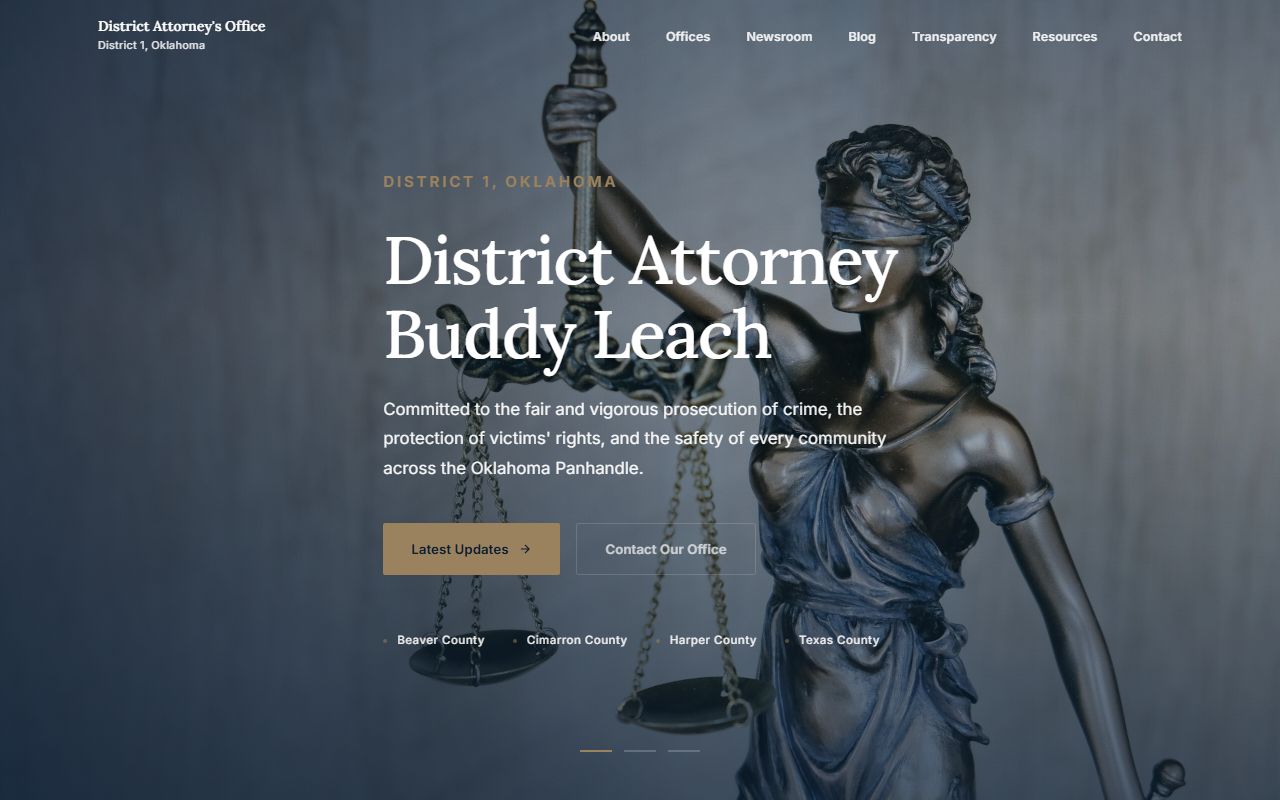
The DA source helps explain why an arrest charge at booking may not match the final filed charge in court.
Find Harper County Court Records
For court records after a jail arrest in Harper County, start with OSCN Docket Search. Choose Harper County District Court if the county or court dropdown is available, then search by party name, case number, or citation number. If the arrest was recent, a case may not appear until the prosecutor has reviewed law-enforcement reports and the Court Clerk has entered the filing. Weekends, holidays, and multi-agency arrests can add delay.
The OSCN docket search page includes Harper County District Court in the statewide court search structure.
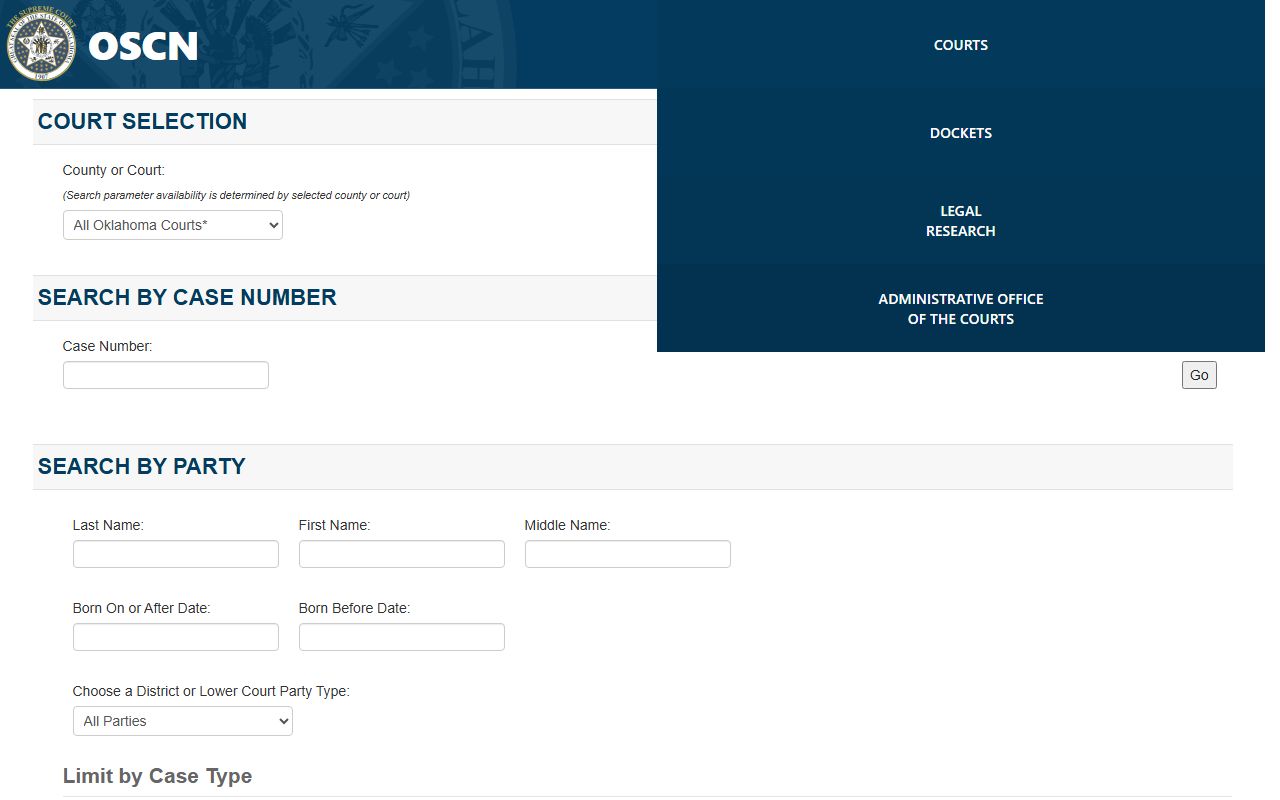
OSCN is the best first stop when a Harper County arrest has become a district-court criminal case.
| OSCN Field | Type | Use for Harper County |
|---|---|---|
| County or Court | Dropdown | Select Harper County District Court when narrowing the search. |
| Case Number | Text | Use a known CF, CM, TR, or other district-court case number. |
| Last Name / First Name / Middle Name | Text | Search the defendant's legal name, then try variants or aliases if needed. |
| Born On or After / Born Before | Date | Use birth-date filters to separate people with similar names. |
| Party Type | Dropdown | Use Defendant or All Parties for criminal case searches. |
| Limit by Case Type | Dropdown | Try Criminal Felony, Criminal Misdemeanor, Criminal Probable Cause, Traffic, or Search Warrants. |
| Cases Filed After / Before | Date | Filter recent arrests once a filing date range is known. |
| Citation Number | Text | Use for traffic or citation-linked district-court matters. |
Harper County ODCR Records
On Demand Court Records, usually called ODCR, is the other main public search route for Oklahoma district-court records. Harper appears in the ODCR court dropdown. ODCR can be useful when an OSCN search is incomplete, temporarily unavailable, or easier to filter through another layout. The same warning applies: a jail arrest is not always a filed court case on the same day, and a court case can be sealed, restricted, dismissed, or absent if the prosecutor declined to file.
The ODCR search page gives a second public path into participating Oklahoma court records.
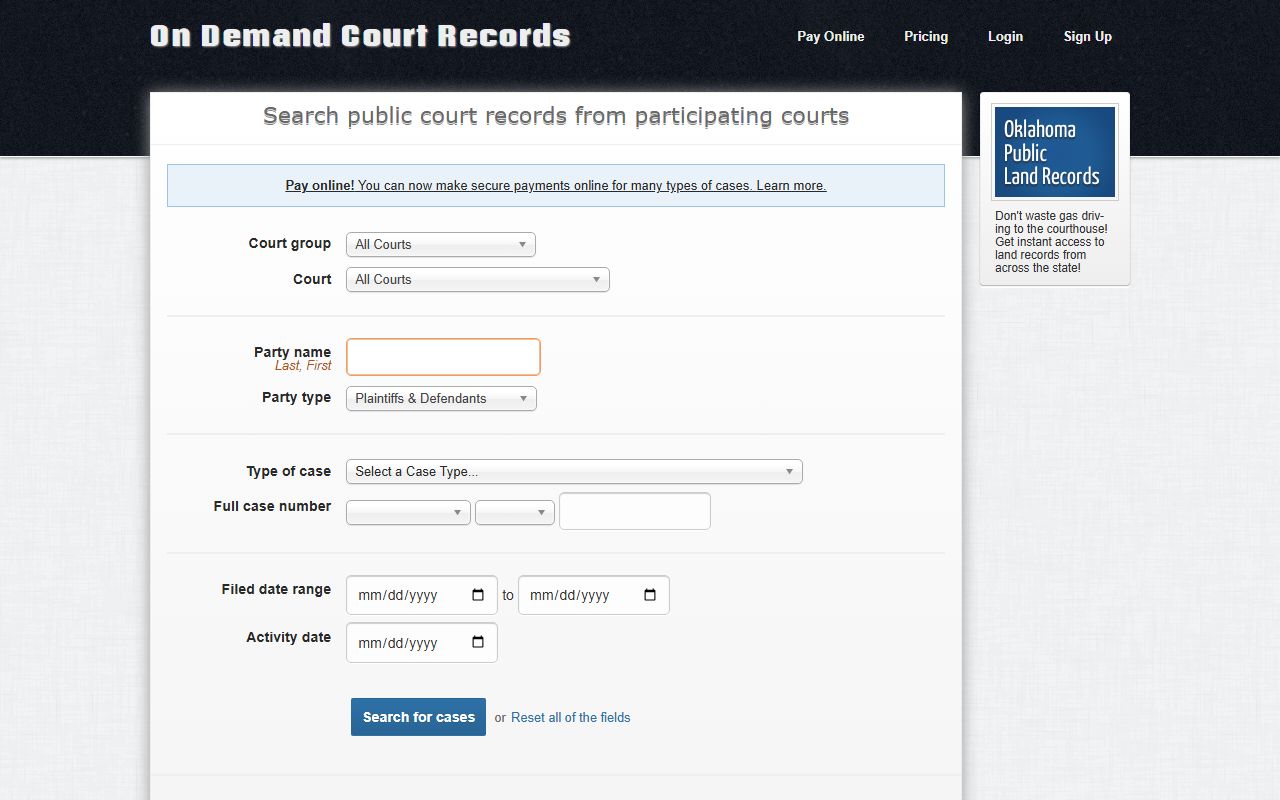
Using ODCR alongside OSCN reduces the chance of missing a Harper County case because of a portal limit or search setting.
| ODCR Field | Type | Search Notes |
|---|---|---|
| Court group | Dropdown | Use Oklahoma District Courts for Harper County criminal cases. |
| Court | Dropdown | Select Harper when available. |
| Party name | Text | ODCR shows a Last, First name format. |
| Party type | Dropdown | Use Plaintiffs and Defendants or All Parties when unsure. |
| Type of case | Dropdown | Criminal felony, criminal misdemeanor, probable cause, search warrant, and traffic filters may apply. |
| Full case number | Structured fields | Use the prefix, year, and number when a case number is known. |
| Filed date range | Date | Helpful for recent arrests that may have turned into new filings. |
| Activity date | Date | Use to find cases with recent hearings, warrant returns, or docket events. |
Charging Records After Arrest
After a jail arrest, the prosecutor decides what charge, if any, should be filed. A booking charge is an arrest-stage label. A filed charge is the court accusation that appears in the district-court case. In Harper County, this review is handled by District Attorney District 1. The filed document may track the arrest report closely, or it may use a different statute, a lower level, added counts, fewer counts, or no filing at all.
| Document | Who Uses It | What It Does | Harper County Search Point |
|---|---|---|---|
| Complaint | Officer or prosecutor | Begins or supports a criminal accusation, often early in the case. | Look for the case filing, probable-cause entries, and initial docket events. |
| Information | Prosecutor | States the formal charge or charges the DA chooses to pursue. | Read charge counts, statute references, amendments, and disposition entries. |
| Indictment | Grand jury | Accuses a person after grand-jury action, usually in more serious or special matters. | Search by defendant name and case number, then confirm with the Court Clerk if needed. |
A court record can also contain bond orders, bench warrants, returns of warrant, plea entries, continuances, and sentencing events. The Harper County Court Clerk, Susan Breon, is the local court-record contact at 311 SE 1st Street in Buffalo, phone (580) 735-2010, fax (580) 735-2787. Court staff can help locate public case records, but they do not replace legal advice.
Harper County Charge Status
Charge status is where court records after an arrest often answer the question that a jail record cannot. A jail record may show that someone was booked on a suspected offense. The docket may later show whether that offense was filed, amended, reduced, dismissed, or resolved by plea or trial. A status term is not a moral judgment. It is a case-stage label tied to a court event.
| Status | Plain Meaning | Why It Matters |
|---|---|---|
| Pending | The case or charge is still open. | Check future court dates, bond terms, and warrant entries. |
| Amended | The filed charge changed after the original filing. | The docket may show a new count, statute, wording, or level. |
| Reduced | The charge was lowered to a less severe charge or level. | Often occurs through plea negotiations or prosecutorial review. |
| Dismissed | The charge was dropped by court order or prosecutor action. | A dismissal is not the same as expungement or automatic removal from all records. |
| Nolle prosequi | The prosecutor declined to continue that charge. | The phrase is often shortened to nolle pros or nolle, and the docket context matters. |
| Disposed | The court has entered a final outcome for the charge or case. | Read the judgment, sentence, or dismissal entry rather than relying on a summary label. |
Note: A recent Harper County arrest may be confirmable by jail phone before any charge appears in OSCN or ODCR.
Bond and Warrant Records
Bond information can sit in both jail practice and court records. The Harper County Jail can confirm whether a person is in custody, whether bond has been set, and whether another hold blocks release. The court docket may show the judge's bond order, bond changes, failure-to-appear events, bench warrants, and returns. Call the jail at (580) 735-2213 before traveling to post bond because Harper County does not publish a jail-specific payment-method page.
No official Harper County active-warrant list, sheriff warrant-search page, most-wanted page, or sheriff app warrant lookup was located in the research. A warrant tied to a Harper County court case may still appear as a docket event in OSCN or ODCR. The Court Clerk can help locate a public court file, and the Sheriff's Office can state what warrant information it confirms by phone or in person. Anyone who thinks a warrant exists should consider legal counsel before appearing at the courthouse or jail.
| Bond or Hold | Meaning |
|---|---|
| Cash bond | The court requires cash payment of the required amount or portion before release. |
| Surety bond | A licensed bondsman posts the bond and becomes responsible for appearance terms. |
| Personal recognizance | Release is based on a promise to appear, often with conditions. |
| No-bond hold | Release is not available until a judge changes the order or the hold resolves. |
| Detainer | Another jurisdiction or agency asks the jail to keep custody or give notice before release. |
Charge vs Conviction Records
Being arrested and charged is not the same as being convicted. Court records after a jail arrest may show an accusation for months before there is a plea, trial, dismissal, or sentencing entry. That distinction is important when reading Harper County court records, OSBI history results, and private background tools. A charge can be public and still not be a conviction.
| Point | Charge | Conviction |
|---|---|---|
| Stage | Accusation filed in court after arrest review. | Final finding after guilty plea, verdict, or qualifying court outcome. |
| Proof level | Based on probable cause and prosecutor filing decisions. | Requires plea or proof beyond a reasonable doubt at trial. |
| Docket clue | Count, statute, amended count, or pending entry. | Judgment, sentence, plea, verdict, or disposition entry. |
| Record warning | Can be dismissed or changed. | Can still be appealed, expunged when eligible, or affected by later orders. |
OSBI Criminal History Requests
OSCN and ODCR are court-case searches. OSBI is different. The Oklahoma State Bureau of Investigation criminal-history page explains statewide public criminal-history requests through CHIRP and through request forms. OSBI says public requests need at least a full name and date of birth, and additional identifiers such as aliases or Social Security number can improve matching.
The OSBI request page lists CHIRP, form submission methods, and the public fee amounts.
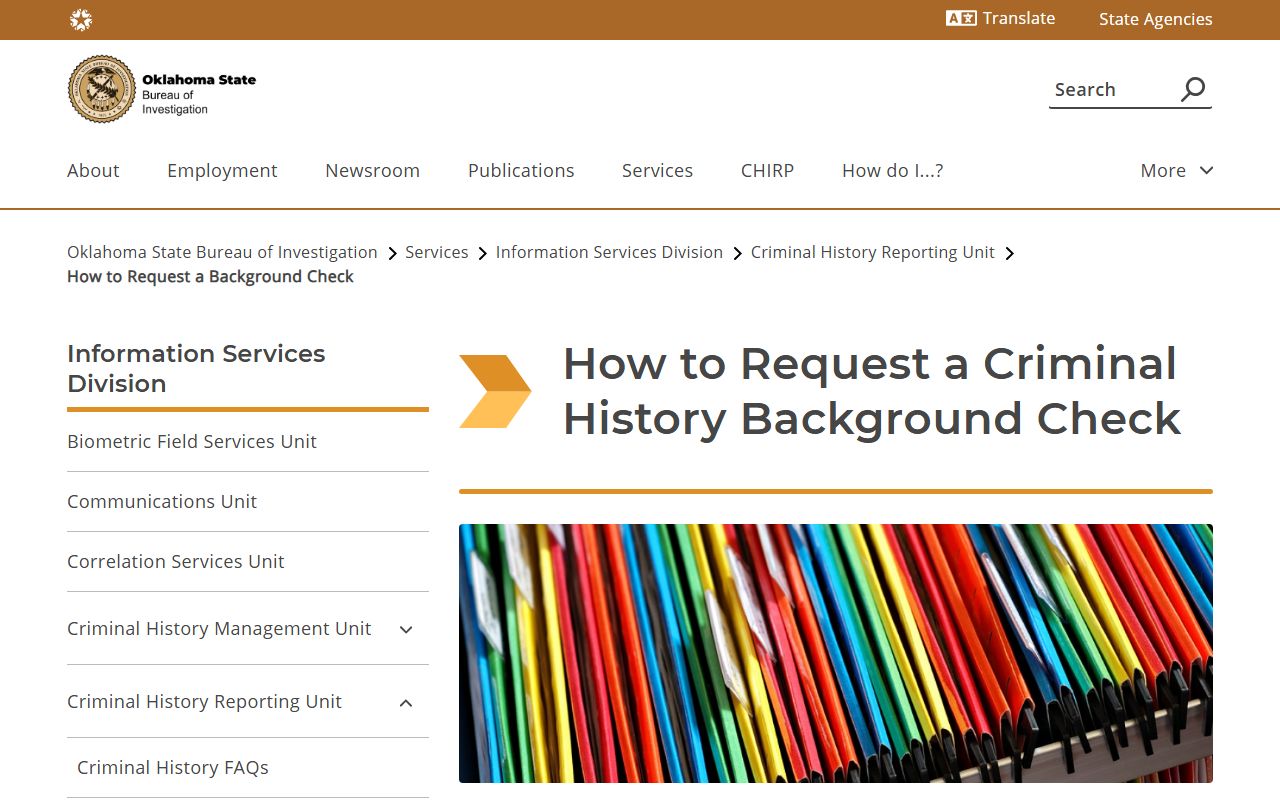
OSBI history is useful for statewide criminal-history research, but it does not replace checking the actual Harper County docket.
| OSBI Item | Amount or Method | Notes |
|---|---|---|
| Name-based criminal history search | $15 | Public requests require at least full name and date of birth. |
| Fingerprint-based criminal history search | $19 | Fingerprint cards cannot be faxed. |
| DOC violent offender search | $2 | Separate search listed by OSBI. |
| DOC sex offender search | $2 | Separate search listed by OSBI. |
| Online request | CHIRP | Use the Criminal History Information Request Portal. |
| Form request | Fax, mail, or in person | Mail to OSBI, 6600 N. Harvey, Oklahoma City, OK 73116, or fax (405) 879-2503. |
| In-person paid requests | 9 a.m. to 4 p.m. | Monday through Friday, excluding state holidays. |
Sealed and Expunged Records
Oklahoma expungement is the legal process used to seal qualifying arrest and court records. Title 22, Sections 18 and 19 provide the main Oklahoma framework for eligibility and procedure. OSBI also has an expungement information page and states that expunging an arrest record requires a $150 OSBI processing fee, with possible local law-enforcement fees. Court-record expungement and arrest-record processing are related, but they are not the same step.
| Point | Sealed | Expunged |
|---|---|---|
| Public visibility | Hidden from ordinary public inspection after a court order. | Handled under an expungement order, often described as treating the record as not public. |
| Where it applies | May apply to court files, arrest records, or related agency records depending on the order. | Depends on the Oklahoma statute, the petition, the order, and the agencies served. |
| Who may still see it | Limited access may remain for courts, law enforcement, or other authorized users. | Access is restricted, but the exact effect depends on the order and law. |
| Harper County action | Check the court case and any sealing order with the Court Clerk. | Follow the court process and OSBI arrest-record processing steps when eligible. |
Important: Harper County Inmate Population is not a consumer reporting agency, and record information may not be used for FCRA-covered decisions.
Restricted Harper County Records
Not every record tied to an arrest is public. Oklahoma's Open Records Act makes many law-enforcement and court records available, but it also allows records to be withheld when another law, court order, or privacy rule applies. Juvenile material, sealed or expunged records, protected victim information, medical information, ongoing investigative detail, and some identifying information can be restricted. A public docket may also show fewer details than the paper file held by the clerk.
For law-enforcement records, 51 O.S. Section 24A.8 covers categories such as arrestee descriptions, facts concerning arrests, offense summaries, radio logs, and jail register or booking information if kept. For general inspection and copying, 51 O.S. Section 24A.5 is the broader public-record rule. The practical Harper County path is to search OSCN and ODCR, then call the Court Clerk or Sheriff's Office when the record is missing, delayed, sealed, or unclear.